Roots & Branches 
Published by
Logan County Genealogical & Historical
Society 
114 North Chicago Street
Lincoln, Illinois 62656
Ph. (217) 732-3200
Hours are Tues., Thur., Fri. 11 am – 3 pm
2nd &
4th Sat. 10 am-1 pm
Web Pages: http://www.logancoil-genhist.org & http://www.rootsweb.com/~illcghs
E-mail address logancoil1839@gmail.com Facebook: https://www.facebook.com/LoganCountyIllinois
YouTube:
https://www.youtube.com/@logancoil1839
SPRING 2026: January,
February, March
Meeting Schedule: All program meetings are at
6:30 pm on the third Monday of each month. The speakers are first on the agenda. We look
forward to seeing you. Please call, Vice-President and Program Chairperson, with suggestions for programs at
217-732-3200.
April 20 – Bill Donath – Jewish Presence in Lincoln and Logan County.
May 18 – Casey Claypool – Rt 66 Scenic Byways
June 15 – Shelly Klinger – Middletown Artifacts and History
Call for Article
Submissions
Members and readers who
have a genealogical or historical story related to Logan County to tell can do so through the Roots & Branches. Stories can be submitted in
writing or by email. These stories will provide a variety. Bill Donath, Editor
Officers for 2026-2027
President: Bill
Donath Vice President: Gary Dodson Treasurer: Diane Farmer Recording
Secretary: Brenda Jones
Corresponding Secretary:
JoAnne Marlin Board Member: Tom Larson Board Member: Rojean
Logan Board Member: Roseann Coers
The Logan County Genealogical & Historical
Society research center will be
closed for the following
holidays: New Year’s Day, Good Friday, Memorial Day,
4th of July, Labor Day,
Veteran’s Day, Thanksgiving and the day after,
Christmas Eve Day,
and Christmas Day. In the event
any of the holidays fall on a Friday, the center will also be closed the
following Saturday.
17
Board Member Contact
List
Our experience with the
cold weather in January and February made us realize that we need to have a way
for people to
contact us when the weather is a concern for driving to LCGHS. We provide these
two phone numbers for
that purpose. Bill Donath - 217-737-8675 JoAnne Marlin - 217-828-0650
Please help us with
Fundraising Activities
LCGHS has two dates
scheduled for the Country Aire Restaurant in Atlanta, Illinois. On May 6, 2026,
and Sept. 9,
2026, all you have to do is eat at the restaurant any time during the day and
LCGHS receives at portion of the receipts for your participation.
So, bring friends and enjoy a good meal.
Youtube - Updated.
LCGHS has the following videos on Youtube. Click here to go there.
https://www.youtube.com/@logancoil1839
79. History of Edward’s Trace https://youtu.be/Y6LKmMN5GnA
80. Civil War Stories #18 Reconnaissance https://youtu.be/2GuHFV0GCBE
Following the brutal
weather of January 2026, I thought it informational to share with you the weather extremes of
the 1830’s in this territory we now call Logan County. The two events shared
here took place in 1831
and 1836 respectively. The first was named the Deep Snow of
1830-31 and the second became known as the Sudden Freeze of 1836. Keep in mind
that in 1830 there were no towns in the territory we know as Logan County. The farm families were completely
self-sufficient. It was up to them to prepare for extreme weather events like these. In 1836,
Middletown was the only established settlement in the territory. Postville and
Mt. Pulaski had been
laid out in 1836, so they were in the early stages of
development. But, even so, traveling to them would not have been possible.
The Deep Snow Of
1830-1831
History of Logan County,
1911, Lawrence B. Stringer, Chapter III, p89-91
The "deep snow" of the winter of 1830-31, to which reference has already been
had, was not
only one of the most remarkable meteorological phenomena ever experienced in
Central Illinois, but it marked a dating point, for every antecedent or subsequent event, in
the history of the early settlers.
"Before" or "after the deep snow" was a chronological
expression, similar to the much later one of, "before" or
"after the war." The snow began to fall in the latter part of November and
continued to fall, until it
reached a depth of three feet or more on the level. Then came
a rain, with the weather so
cold, that the rain froze as it fell, forming a crust of ice, over this great depth of
snow, nearly,
but not quite, strong enough, to bear up the weight of a man; and finally, over
this
crust of ice, came a few inches of light snow. The clouds passed away and the wind came down, from the
northwest, with extraordinary
ferocity. For weeks, the mercury was no higher, any morning, than twelve degrees below zero.
The air was filled with flying snow, which blinded the eyes, and almost stopped the
breath of any one who attempted to face it. The settlers were all
largely from regions
to the south of this, had never experienced anything of this kind and were wholly
unprepared for it. It is not difficult, therefore, to give due credence to the
stories of
suffering and destitution which its prolonged visitation entailed.
When the storm came, it found most of the corn standing on the stalk. It had
been warm and
wet. and the settlers had been in no hurry
to gather the corn. They were so unprepared for such an extreme season that it became almost
impossible, in many cases, to obtain bread for family use, although amid
stacks of wheat
and fields of corn. Few had any milling done, and all sorts of devices were
used to reduce
what little grain that could be dug out of the snow into anything resembling
bread. Watermills, few as they were,
were frozen and
stopped. Roads were obliterated and it was useless to make new ones in the snow,
for the drifts
filled them up as fast as made. Stock perished for want of sustenance, as
also did hogs
and poultry, in great numbers.
Nearly all kinds of game were destroyed, especially the deer, which being
unable to run in
the snow, fell an easy prey to the hunter and his dogs. Prairie
chickens, with their well
known habits of roosting on the ground, were destroyed by hundreds. Apple and peach
trees were
invariably killed. Prior to the "deep snow," this section was
considered the
greatest fruit country known, but since the "deep snow," it has never
recovered its prestige
in this regard. It is also a well-known fact, that cotton was grown in what is
now Logan
County, prior to this remarkable weather, but none since.
David England, who settled in Sangamon
County, close to the present Logan County line, said in 1870: "Previous to 1831,
we raised plenty of cotton, without
cultivation, all we wanted, but after
the deep snow, there was a change in
climate, and it has not been the same
since, as every old settler can testify. My father had a cotton gin, which
consisted of two
rollers turned by hand." Cotton was raised in considerable
quantities in the Buckles' settlement in the Lake Fork country, before the "deep
snow" as before noted in the chapter on early settlement.
Elisha Primm, of Sangamon County, used to relate that his father built a
cotton gin in 1822.
He said that from the time the first settlers came into the county, until
1831, this was
as good a cotton country as Georgia. He
said that this was attested by men familiar with cotton growing in the south. Elisha attended the
gin built by his father, which was run by horse power.
The people brought
cotton to be ginned, from all distances up, to twenty miles. Sometimes it would accumulate on his
hands, until he would have as much as three thousand pounds. The price for ginning was a toll of
one pound in every eight, after the cotton was ginned. It sold from 12
to 16 2/3 cents
per pound and occasionally higher. But
after the "deep snow," he said that the seasons appeared to shorten, and
cotton was generally
bitten by the frost before it had time to mature, and cotton raising was
abandoned.
-John Buckles, during his lifetime, said - that though only nine years of age, he remembered the
"deep snow" quite vividly. He
described it as follows: "The snow began falling about Christmas and continued
until it was
three feet deep on the level, and four or six feet deep where it drifted. A cold
wave, following
the snow, froze the surface into a thick hard crust, strong enough to
bear the weight
of team and sled. Deer and wild turkeys became so tame, through desire
for food, that
they ventured near enough to the cabin of the pioneers, in some
instances, to be fed
from the door. Before the opening of spring, much wild game was killed, by the merciless wolf or
perished from starvation. Families not
having prepared for such a trying time, and being housed only in open-built huts, were in
many cases frozen to death,
while others suffered cruelly from lack of food. The difficulties and adversities
through which
the people of that winter passed, and the misery and suffering they
underwent, are
indescribable and inconceivable, and those who survived it and are yet living,
recall to memory
or speak of it, with ghastly
recollection of its horrors."
Christopher C. Ewing, in writing to the Old Settlers' Association, about the
"deep snow,"
said: "During this winter, we had to hitch two or three yoke
of oxen, to a sled, to
drive out into the field, and get some
corn for ourselves
and the stock; and we would find our trails, completely covered up, on our return. The snow
was two or three feet deep,
on a level. Sundogs followed the sun all day, and the weather
was bitterly cold. We got
through the winter with a lot of poor stock."
James Randolph, at the Old Settlers'
meeting in 1875, said that he came to the county, with a colony of fifty persons;
that they came from a warm country and
the men spent the fall in hunting,
instead of finishing their cabins and
that only two cabins had chimneys when
the big snow came; that by spring
forty-nine of the fifty were in the two
cabins that had chimneys, one having died; that nearly all were sick, they had no
doctor, and a number of the settlers
became discouraged with the outlook and
went back home.
Samuel Hoblit used to relate that he moved into his new log house, near the present site of
Atlanta, "the day of the
commencement of the deep snow," that the house was somewhat open, not having
had it finished
and "that the snow of that long
winter, lasting eighty days, without a thaw, continually drifted in, until, under
the bed, it reached
the cords, where it became packed and was allowed to remain until
spring."
David Ward Clark, one of the first presidents of the Old Settlers'
Association, is
authority for the statement that, during the winter of the deep snow, the house
tops were covered
with prairie chickens, which died by the thousands.
Jacob H. Judy, in his lifetime, always claimed that the snow was five feet
deep, on an
average, and drifted, in places, to fifteen and twenty feet.
Ford Ewing used to relate that during this period, he, and his brother, ran down eleven half starved,
scrawny deer, which they
afterwards fattened, but could not domesticate. This great snowfall produced constant sleighing
for nine weeks, and when, at last, warm rains
and sunshine prevailed, the roads remained as lines of ice, which disappeared but
gradually. The streams were raised, by the melting snow, to an unusual height.
and thus passed
away this epoch-marking event.
THE SUDDEN FREEZE OF 1836. History of Logan County, 1911, L. B. Stringer,
Chapter III, p91-94
About five years after the "deep snow," or to be exact, on
December 20, 1836, another meteorological event occurred,
in the history of
the county, which has likewise not been surpassed, since that time. This event
was known as
the "sudden freeze." Rain and sleet had been falling in the early
afternoon, when
without warning, a strong wind, traveling at the rate of at least seventy miles an hour, accompanied by
a deep, bellowing sound,
with its icy blast, swept over the county, and everything was instantly frozen hard. The water of the
little pools in the roads froze in waves, sharp-edged and pointed, as the
gale had blown
it. Chickens, pigs and other animals were frozen in their tracks. Wagon
wheels,
ceasing to roll, were frozen to the ground. Men, going to their barns or fields, in slush and water, a
short distance from their houses, returned a few minutes later, walking
on the ice.
Some caught out on horseback, were frozen to their saddles. Ice was
frozen in streams,
from six inches to a foot thick, in a few hours. John Buckles, of Mt.
Pulaski, gave the
following version of this event, during his lifetime: "On the morning of the sudden change, it was
warm, the atmosphere was
saturated with moisture and on the ground was a light layer of snow. About noon,
rain began to
fall for a time, when without a moment's warning, an icy wave swept down from the north, freezing
everything as it went.
Underfoot, was a slush of snow and water, but in less time than
it takes to write it, the polar blast converted it into solid
ice.
Carter T. Scroggin, who was on his road from a neighboring mill, in an old
Durbin, was struck
by the frigid wind. The top of his Durbin was removed and his horse faced
in the opposite
direction. Realizing the peril of his situation and knowing that if he
did not find
shelter immediately death would claim him, he drove rapidly in search of some friendly cabin,
which he found in time to save his life. Those who had the misfortune
to be overtaken
by this icy terror and were unable to find shelter, quickly succumbed and much stock was
numbered among the frozen
victims."
Christopher C. Ewing, of Lawndale, now deceased, reporting this event, said:
"In December
of 1836, our pioneers experienced another severe change in the
atmosphere and lost
heavily of their stock and poultry, and in some cases their own lives. The snow had been falling for
a day or two, when a drizzling rain set in, which continued until
about two o'clock,
in the afternoon, melting the snow and converting it into thin, mushy
ice. Suddenly, there came a mighty,
rushing wind from
the northwest, which roared at a distance, like a hurricane, and froze everything in its course. The water on the ponds was frozen in waves and all who were out, suffered more or less, as in an hour, the mercury changed from forty degrees
above to thirty
degrees below. This severe weather continued three days and resulted in much sickness
throughout the country."
J. T. Hackney in an Old Settlers' talk
at the annual
meeting, recalled the sudden
change. "The earth was wet from recent rains," said he
"when suddenly a cold wind came, which seemed to whiten the
earth. Three of us were caught in this
storm and the
ice becoming thicker and thicker and the cold more intense, we were compelled to
stop at the
house of Alfred Sams for safety."
Ezekiel Bowman, one of the early sheriffs of the county, used to say that after
the sudden freeze,
he found frogs frozen, with their mouths open, and he
verily believed that the change was so sudden, they didn't have
time to close
them.
John Hepperly, of Lincoln, illustrated the suddenness of the change, by saying
that it was
"sudden as a clap of thunder."
The father of Abe Larison had a narrow escape from death, at the time, his clothing being frozen
on him and he frozen to the
saddle, when he arrived at his home. Many cases of subsequent death among the early settlers were
due to exposure during the storm, and much sickness followed.
James Harvey Hildreth, who died in Mt. Pulaski township in 1858,
underwent such an
amount of suffering, during this sudden change, that, in after years, he
rarely ever cared
to refer to it. He came to this country in 1833 and was engaged in cattle
trading. At this
time, he was a stout and rugged young man, of about twenty-four years of
age. In December
of 1836, he, in company with a young man, by the name of Frame,
started, on horseback,
for Chicago. On the day of the sudden freeze, they had entered the
border of a large
prairie, in the northern part of the state, and the next timber was many miles
distant. It had
rained all morning, and the earth was covered with water. They encountered a slough, containing
so much water, they did not
like to attempt passing through it. In order to head the slough, they rode some miles
in a northeasterly
direction, and having crossed it, turned northwest. to regain their
course. That was
about the middle of the afternoon. It suddenly ceased
raining and the cold wave
came, in all its fury, from the northwest,
striking them square in the face. They were then out of sight of any human
habitation, and their
horses became absolutely unmanageable. They drifted with the wind or across it, until dark closed in
upon them. The cold becoming
more intense, death seemed to be imminent. As a last resort, they decided to kill their horses, take
out the entrails and crawl into the carcass, as a protection against the
cold. They dismounted,
killed Frame's horse first,
disemboweled it and both crawled into the carcass, as far as they could, and remained there until
midnight. The animal heat, by this time, having been dissipated, they crawled out, with the
intention of slaughtering
Hildreth's horse. In some way, however, they lost the only knife they had, and could not find it in the darkness. They then huddled
about the living
horse, until about four o'clock in the morning. By that time Frame had
become so benumbed
by the cold, that he sank to sleep and while in this stupor, froze to
death. Mr. Hildreth, in the
meantime, kept from
freezing, by jumping about. As soon as it was daylight, he mounted his horse and
started in search
of shelter. In mounting, he dropped his hat, but was afraid to dismount and
get it, for fear
he would not have strength to mount again. Bareheaded, he rode about,
until he reached
the bank of a stream, supposed to be the Vermillion River. Seeing a house
on the opposite
shore, he made an outcry, which brought the occupant out. This did him
little good,
for the occupant, whose name turned out to be Benjamin Russ, was
one of those inhuman
outlaws, who were occasionally to be met with in the timber. Russ yelled to Hildreth, that he
could not do anything for
him. A canoe was lying tied to the opposite shore, but he affected
to be afraid of the
running ice. Hildreth then offered him a large sum, if he would
cut a tree and let it fall over the stream, so that he could cross.
Russ still refused
and directed Hildreth to a grove, which he said was a mile distant,
where he would
find a house. He went, but it was five miles, and the house proved to be a deserted cabin. He
then returned to Russ' house and called for help and was again refused.
He then dismounted,
crawled to the bank, found that the ice had closed, and was strong
enough to bear
him and crawled over. Arriving at the fence, the brutal owner of the place
refused to help
him. Hildreth tumbled over the fence, crawled to the bank and laid down near the fire. He was allowed to lie there, until four o'clock that afternoon, but no
assistance was given
him, either by Russ or his wife. Finally, some hog drovers
came along and moved him
to another house, where he was properly cared for. Afterwards, the settlers of the neighborhood,
hearing of the inhumanity of
Russ, decided to mete out severe punishment but Russ and his wife fled the
country. Mr. Hildreth always expressed
the belief, that his offering to pay liberally, for cutting
down a tree
across the river, led them to think that he had a large sum of money, and that,
if, by their neglect,
he perished, they could obtain it. Mr.
Hildreth was conveyed back to the house of his brother in Vermillion County,
where all his
toes were amputated from both feet and the bones of all his fingers, except
one joint of the
thumb, on his right hand, which enabled him to hold a pen or drover's whip.
His left foot
never healed entirely and nearly twenty two years
after his misfortune his leg had to be amputated below the knee. This healed,
but his lungs,
already diseased, caused his death as before stated.
Remember to eat at the
Country Aire on May 6.
22
While we are talking
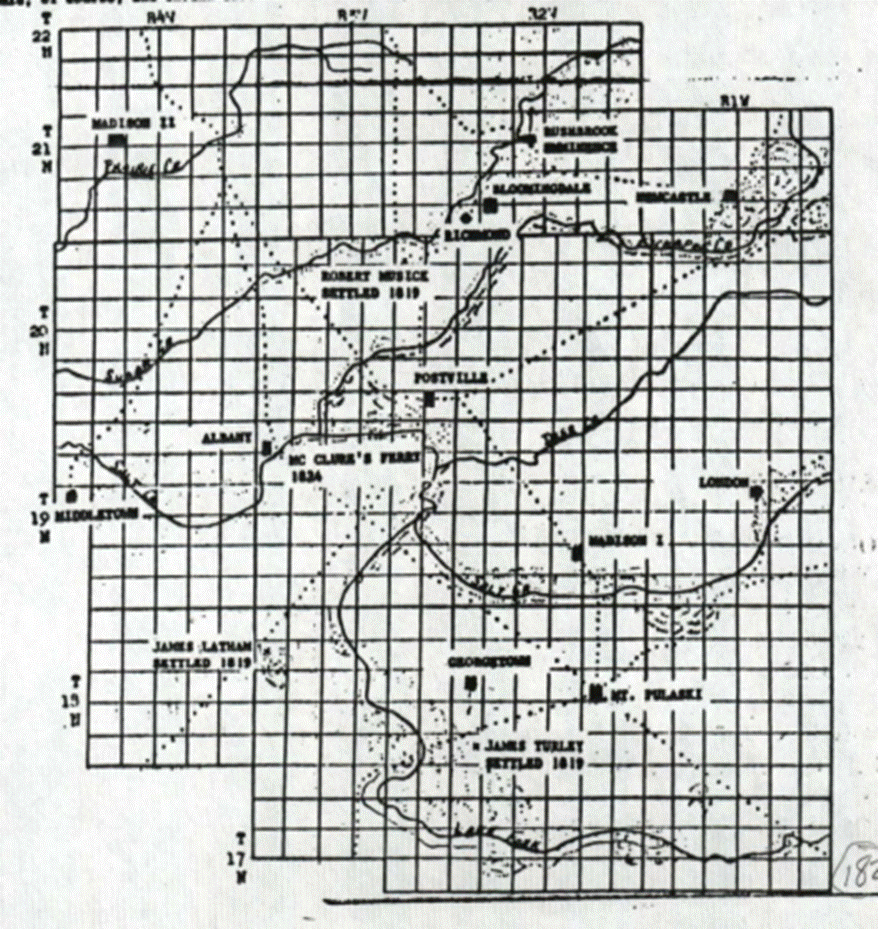
about the 1830’s let’s take a look at the Boom Towns,
The Paper Towns that did
not make it off the drawing board. The real estate bubble of that
day (1837) burst before any work could start on the towns listed in this
article. Keep in mind that before 1839 Logan County was part of Sangamon County. The County Seat would
have been Springfield. A map of other Boom towns follows this article
Town Surveying &
Building In Logan County
By: Robert W. Mayer
Mt. Pulaski Weekly News,
October 10, 1988, p17
“Logan County was established in 1839 by carving the region out of Sangamon
County – all except the northern tier of townships which were taken from Tazewell County and added to Logan in
1840. I compiled the map, for not better reason than my own amusement, and not to represent
the region as it was on any
particular date, but to depict some of the interesting conditions and events
there during the
1820’s and 1830’s just before it became Logan County.
“The natural features – water courses and timber – were taken from the plats of the original surveys,
most of which were made
before the Federal Land Office in Springfield was opened in 1823, and all of which
are still on
file in the Illinois State Archives. Note that the hill now occupied by Mt. Pulaski
was not timbered.
(Incidentally, Mt. Pulaski Hill and Elkhart Hill “Komes,” mound of almost pure sand deposited
by prehistoric subglacial rivers where they emerged from the ice.) Note
also that Lake
Fork – that is to say, the lake fork of Salt Creek – really was a lake, at
least during the
rainy season. During the dry season it was a mere swamp. Many of the township
lines were not precisely where they are
today, mainly because chain was so
scarce in the frontier in those days
that surveyors were often obliged to use
thongs (leather strips) which stretched
considerably when the weather was humid,
of course, and shrank when it was dry –
so that even a basic distance might
yield significantly different measures on
successive days.
‘The locations of the various trails – leading to Springfield on
the southwest, to
Fort Clark (now Peoria) on the northwest, to Bloomington and Clinton on the
northeast, and to Decatur on the
southeast – were derived from bits and
pieces of information in a variety of
sources; The Interstate Publishing
Company’s History of Logan County (1886), Judge Lawrence Stringer‘s History of Logan
County (1911), early plat
books showing roads (such as the ‘grape
vine road’ running northeast from Mt.
Pulaski) which undoubtedly followed
the lines of ancient trails, and an old
Illinois atlas in the University of
Illinois Library. It should be noted
that the locations of the trails were very
approximated and were subject to
considerable change from time to time; they followed the high ground during the
rainy season and much of the low ground
was bottomless mud, Impassable even for
a rider on horseback, but in the dry
season they took short cuts across the
prairies.
“The locations of the very Early settlements – James Latham’s on
Elkhart Hill, Robert
Musick’s on Sugar Creek, and James Turley’s on Lake
Fork – are to be found
in Judge Stringer’s History.
“Judge Stringer’s History was also the principal source of dates on the thirteen ‘Boom Towns’
– supplemented, however, by
the original plats filed in Springfield, seat of Sangamon County, and in Pekin, seat of Tazewell
County.
“The town lot boom of the 1830’s was one of the most interesting and exciting episodes in the early
history not only of our region but of all central Illinois. Middletown
(1832) and Mt.
Pulaski (1836) are the only ones to
survive as independent towns. Postville (1835) survived as part of
Lincoln. Bloomingdale (1836) had a few buildings for a few years. All the rest – Georgetown
(1829, Richmond
(1834), Rushbrook (1834), Albany (1836), Eminence
(1836), New
Castle (1836), and London (1839) – were purely
fictitious in the sense that they had no physical existence. The proprietors of
a town need
only have a site surveyed and filed a plat in the office of records in the county
seat. And the
lots depicted in the plat became articles of
commerce – just like shares of stock in a corporation – to be traded actively, even feverishly, in
the real estate markets of
Boston, Providence, and New York.
Incidentally, Abraham Lincoln himself signed the plat
of Albany as Deputy Surveyor
of Sangamon county. Like all such speculative episodes,
the Town Lot Boom came to a sad end within a few years – as had the Mississippi
Bubble of the 1720’s and the
Florida Land Boom was to do in the 1920’s.”
 24
24
A Funny Hoax
Lincoln Herald, Lincoln,
Ill., Feb. 29, 1860
“A letter was received in this city yesterday morning from of the principles in the
late duel (!) at
Lincoln, and the gentleman to whom it was addressed brought it to our office and
allowed us to
throw our eyes over it. It was right funny. From a careful perusal of it we are
satisfied that an
extensive ‘sell’ was perpetrated upon the inhabitants of the thriving borough of
Lincoln, and it
is more than likely that a few of our citizens allowed themselves to be sold for less
than the price
of an old song. It seems that the two fighting men have been waiting patiently, and
it is supposed
some somewhat nervously, for squalis, and one of them
(Y.) said to the other, (W.) ‘I’ll bet you and oyster supper that mine
screams first.’ W. is said to have
replied, ‘Now you’re talking
sense; I’ll take that bet and am willing to double the stakes.’ But Y, replied that he
was not a sporting
man, and that he considered the stakes quite large enough for the occasion; so the parties, separated, with a fair understanding
that the loser of
the wager was to pay for an oyster supper that should not cost less than $5. Fortune
favored Y., for
the wail of a newborn babe
was heard in his house
six hours before a similar sound entered the ears and gladdened the heart of his
neighbor W. On the following day Y
signified to W. his
readiness to eat a large number of
oysters at his (W.’s)
expense, and W. acknowledged that he had lost the bet and expressed that his
willingness to
comply to its conditions. By some means not generally known,
it became town talk in Lincoln that Y. had challenged W. to mortal
combat, and most
of the inhabitants were thrown into a high state of excitement. The two happy fathers concluded to
humor the joke, and we are informed that when they were advised by the respective friends to compromise the matter, they
replied that
they did not need any assistance in the settlement of their difficulties. It
will readily be
supposed that their apparent thirst for each other’s blood did not tend to ally the
excitement, and we
venture to say that the good people of Lincoln were completely unfitted for their
usual duties during
the greater part of last Friday. The arrangements for the duel having been made, privately of
course, the Lincoln people did not know when or where the combat would take place; but when
Y and W rode out together in the direction of Postville, they were
followed by a pretty
large crowd.
“We do not know how long a chase the two friends led their followers over the
prairie, but presumed
they rode till some of their train got an inkling of the joke. The oyster supper
doubtless came
off in good time, and the probabilities are the happy fathers and a few of their intimate friends made
the most of the occasion. – Springfield Journal, 22nd.”
Burying Ground Lincoln Herald, Lincoln, Ill. Feb. 8, 1860
“It is appointed that all men shall die, and amongst Christian people it is always
desirable to have a secluded spot
devoted to burial purposes, where the
dead may rest in peace and where their
friends may be assured that the mounds they erect over the last earthly resting place of the
deceased may never be upturned by the
plowshares, or desecrated by
cultivation; but that it shall be
secluded in location, undisturbed in its solemn
and solitary grandeur
and sacred in remembrance
of its sleeping dead.
“We therefore hereby announce, that each of the undersigned has a book for the
reception of names,
and solicit the co-operation of the neighborhood in the purchase of about
seven acres of
ground for burial purposes, near the bridge on Salt Creek, and embracing the present burying ground there.
Full particulars will be given by
25
either of the
undersigned. Theodore Stryker; George P. Noble, William Rankin,
L. P. Lacey”
Curious
Lincoln, Herald,
Lincoln, Ill., Jan. 25, 1860.
“Mr. B. F. Manly has left at our office a piece of wood,
bearing the mark of an axe or some other sharp instrument, found while digging
a well near the
Christian Church, in this place, seventeen feet beneath the surface of the earth. The
wood is somewhat
decayed. Never, since the settlement of
this country, has there been any human contrivance by which this piece of
wood could have
been deposited in the deep sepulchre from which it has now
been exhumed. It is a
hieroglyphic of some ancient and forever lost human history.”
Errata.
Lincoln Herald, Lincoln,
Ill., Feb. 25, 1860.
“A blunder in an editorial of last week made us advocate both Lincoln and Bates
for the Presidency.
How it happened we hardly know. We are
for Lincoln, as we stated, all the time. We would rather see him nominated than
any other man
in the field. We would regret the nomination
of Mr. Bates. Both for National and State policy, we cannot deviate from ‘Old Abe.’ LINCOLN and
HICKMAN, is our ticket, as we have iterated and reiterated, and as we
shall continue to do
until they are elected, or other parties are nominated.”
From Mt. Pulaski Lincoln Herald, Lincoln, Ill., Feb. 29, 1860.
“Ed. Herald: If not trespassing upon your good nature, I would like, through the
medium of your
valuable journal, to inform the citizens of Logan County of the patriotism of the
citizens of Mr.
Pulaski. You are aware that the 22nd of February was the anniversary of the birth of our glorious
Washington. It being so, the Young
Men’s Literary Association of this place, having obtained the consent of the school directors
for the use of the Court House, at once
gave out a prospectus of the celebration
to be had in the evening at the
aforesaid place, and when the hour
arrived, the Court House was filled with the good citizens of Mt. Pulaski. The House was call to order by the
President of the association, Mr. D.
VanHise, when Addresses suitable to the occasion were
delivered, in an eloquent manner, by Messrs. Whitaker, King, Reiser,
St. Clair, Lushbaugh,
and Master Frackelton; after which, a call was made for toasts, by the president, and a
hearty response was made by
both ladies and gentlemen – a few I will make
mention of. Were I to give you all that were made,
I would most surely trespass upon your, too good, nature;
Washington – The morning star of the Revolution. – L. C.
The Union – May the golden chain that has bound her together be perpetrated till
time shall end.
Washington – The first in war, first in peace, and first and forever in the hearts of
the American people.
– St. C.
Washington – May his memory ever be venerated by the ladies of our beloved
country. – J. S.
The 22nd of February 1732 – The beginning of a new era; the head of a new world. –
A. E. C. The Birthday of Washington – May its annual return be celebrated by the people of
Mt. Pulaski through
all coming time. L W
The Union - And next November a Republican President – W. W. M.
26
One of the Phases of Slavery Lincoln Herald, Lincoln, Ill. Jan. 18, 1860.
“A little less than a year ago an English gentleman and his family went to spend
some months in
South Carolina for his health. On their return to the North in the spring,
they stopped on their
way at the residence of a British Consul. He was at that time boarding
at a hotel. A
conversation arose on slavery. ‘Sir,’ said the landlord, ‘the slaves have an easy
time, a very easy
time, I have a slave woman in my house whom I keep well, and feed well, and
who done little
or no labor of any kind for six years I have owned her.’ ‘That is very liberal of
you sir,’ replied
the English gentleman.
“Are such cases common?’ ‘O, Yes, very common.’
“The next day the wife of the English gentleman was spending a little time
in the sitting room
of the wife of the landlord. While there, a young, good-looking mulatto woman came
in appearing
languid and complaining of beings sick.
“Her mistress accosted her sharply, saying, ‘What’s the matter now Phillis, are
you going to stop
having children?’
“‘Indeed, I hope so missus, I would rather die than have any more,’ replied the
girl.
“’Phillis,’ said the mistress, ‘don’t let me hear you talk in that way. If you stop
having children, I
will sell you to go South at once.’
“The slave left the room in tears. ‘Is that girl married?’
‘No,’ answered the land
lady.
’How long have you owned
her?’
’Five or six years,’ replied the landlady. ’How many children has
she had since you
bought her?’
“’Four,’ replied the
landlady.
“’All living?’ ‘All fine, fat and healthy.’ The landlady
subsequently disclosed the fact that this was their breeding woman,
bought and kept
for the purpose, and the one to whom he alluded to as having an ‘easy time.’
“Her children had different fathers, chosen with reference to their stock
qualities by the owner
of the girl. She had been made to produce a child in almost every year since she
had been purchased
and the landlord professed to be getting boys and girls by his judicious system
of crossing equal
to any in the State, and which would bring him the very highest prices. In what
way the girl was
coerced into this diabolical arrangement, we have seen by the interview in the
sitting room.
“We do not attempt to heighten the picture. We give the simple facts as related to us months ago by the
gentleman in question, in the
confidence of private intercourse; and for this reason, we do not wish to be more
particular as to
detail. We only vouch for the strict truth of the story.”
Remember to eat at the
Country Aire on May 6.
27
Donors
LCGHS wishes to thank the following people who have made donations
to the Society during the past year. Perhaps it was a monetary donation, a donation of family records, a donation of
time, or some other
donation to make us a better Society. Thank you all and we wish
you well.
Alexander, Abbie
Birnbaum, Karen
Buhrmester, Bev
Cardiel, Shelly
Donath, Bill & Shirley Frampton, Mary Beth Griffith, James
& Barbara Haxton, Claudia
Kroger Co.
Lincoln Woman’s Club Miller, Judith
Nimke, Allen & Ruby Osborn, Diane
Russell, Tammy
Ryland, Patricia
Scharf, A
Sampson, Karen Simpson, Kyle Tarter, Julie
Tremaglio, Carol Walker, Dan
Wilson, R Blake Woll, Marlena Young, Raymond
“I do the
very best I know how – 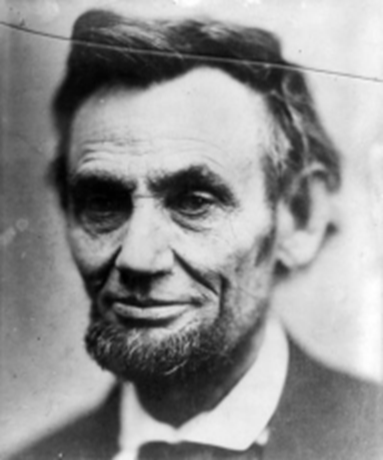
the very
best I can; and I mean
to keep
doing so until the end.” -
Abraham
Lincoln
“If the end
brings me out all
right,
what's said against me
won't
amount to anything. If the
end brings
me out wrong, ten
angels
swearing I was right
would make
no difference.” -
Abraham
Lincoln
In great contests each party claims to act in accordance with
the will of
God. Both may be and one must be wrong. A. Lincoln, September 2, 1862.
28
LCGHS STORE
To order books send a
letter to LCGHS at 114 N. Chicago St, Lincoln, IL 62656, give the name of each
book - quantity and price + S/H for each item. Please include your check for
the total amount, along with your name and address.
It has been interesting
to me how Logan County and the towns within it promoted themselves during the
19th and early 20th centuries. The following
information about Lincoln came from an unknown source. The pages were cut from a larger
book that was likely printed during the early years of the 20th century. Although a date for the publication is not known we can
surmise that it was between 1895, the date of Mr. Latham’s death, and 1902, because there
is no mention of the Carnegie library or the new courthouse. I hope you find it
as interesting as I
have.
BOOKS
A Deeper Dive Into the Better Government
Council of Logan
County, Illinois, Fuller – 2021. $35+$5 S/H.
The Spanish Influenza Epidemic in Logan County, Illinois, 1918-1920, Donath – 2020. $30+$5
S/H.
Abraham Lincoln in Logan County, Beaver - $25 + $5 S/H
Days Gone By (Our
one-room schools) - $38 + $5 S/H
Generosity, The Story of Logan County, During the Great War, Donath-2016 - $30 + $4
S/H
Be Careful Crossing the Hard Road, Detmers - $15 + $3 S/H
Logan Co. Township Maps of one room schools &
Cemeteries; (soft cover) shows location of one room schools & cemeteries in Logan
County. $10 + $3 S/H
This Is My Story, Vol. II; (hard cover) 365 pages Personal stories from Logan County
Veterans who served
in any branch of the Military. $25+$5 S/H
A Pictorial History of Lincoln – Paul Gleason $25 + $5 S/H
The Town Abraham Lincoln
Warned, Henson-2011- $15 + $5 S/H
The History of Logan County,
Illinois - 1982 $150 + $10 S/H
Logan County Courthouse 100th Anniversary;
(soft cover) $10 +$4 S/H
Lincoln, IL, A
Chronology 1953-2003; $5+$3 S/H
1917 Prairie Farmers
Reliable Directory of
Breeders & Farmers in Logan County; 3 ring
notebook & protective sleeves $20+5 S/H or $15 for soft cover
Mason City Centennial Book, $15 + $5 S/H
Echoes From The Branches – G. Rosenfeld $7 + $5
S/H
Elkhart is Like a Box of
Chocolates - G. Rosenfeld $7 + $5
S/H
Glimpses of Lincoln, IL by Jan Schumacker $14.95 + $5 S/H
Mt. Pulaski 100yr 1836-1936 - $10 + S/H Elkhart is Like a Box of Chocolates - $7 + S/H Echoes
from the Branches - $7 + S/H
Glimpses of Lincoln, IL. - $15 + S/H
Lincoln, IL, A
Chronology, 1853-2003, $15 + S/H
Make Tracks to Latham
125th
Anniversary 1872- 1972 - $20 + S/H
Elkhart Sesquicentennial: 2005, $15 + S/H
1999 Logan Co.
Courthouse 2000 Lincoln City Hall 2001 Lincoln Public Library
ORNAMENTS – All Ornaments are $5 each.
2007 The Arcade
Building
2008 Logan Co.
Courthouse
2009 Logan Co.
Courthouse
2002 Abraham Lincoln
Mem. Hospital 2004 Lincoln College
2005 Logan Co Courthosue
2006 Earl Hargrove
Chapel LCC
2010 Lincoln Woman’s Club
2013 A. Lincoln’s 1858
Speech
2015 Knapp, Chesnut, Becker Building, Middletown, IL
Duplicate Books
Available
The following duplicate
books are available for purchase from LCG&HS. High school, college
yearbooks & Directories sell for $5 each + $5 S/H and include:
Lincoln: 1920; 1921; 1922; 1923; 1924; 1925; 1926, 1927; 1928; 1929; 1930; 1931; 1932; 1933; 1934;
1935; 1936; 1937; 1939; 1940;
1941; 1942; 1947; 1948; 1949; 1950; 1951
Hartsburg-Emden: 1956
Lincoln College: 1963; 1972
Mt. Pulaski -
1926, 1927, 1930
Lincoln City Directories
$10 ea.: 1934; 1941; 1955; 1962, 1964; 1967; 1971; 1972;
1973; 1974; 1976;
1977, 1978, 1979; 1980; 1981; 1982; 1984; 1985; 1986; 1987;
1988; 1989; 1990; 1991; 1992; 1993; 1994; 1995; 1996; 1997; 1998; 2000; 2005
ATLAS/PLAT BOOKS
AVAILABLE
Logan County Illinois: 1979; 1993; 1996; 1997 individual - $10 each, 2013 - $35 + $5
S/H McLean County Illinois: 1996 - $10
LOGAN COUNTY PLATES
Emden – 7.5 in: 1871-1971
Emden St. Peter’s
Lutheran Church: 1879-1979 Abraham Lincoln – 10 in: 1853-1953 Abraham Lincoln
-150th Birthday
Abraham Lincoln - Ashtray
Lincoln First Methodist Church-new building Lincoln
Sesquicentennial: 1818-1968 Logan Co. Fair - 50th Anniv.
Mt. Pulaski Methodist Church - 10in
Mt. Pulaski Stahl's Siltennial:
1836-1961 Mt. Pulaski Courthouse Siltennial:
1836-1961 Odd Fellows Home; 1967
Sheers Building
Sheers Courthouse
Sheers Auto Supply
Zion Lutheran Ch - Lincoln
Plates are $5 each plus $4 S/H.
Worrying won't stop the bad stuff from happening. It just stops
you from enjoying the good.
30
Logan County
Genealogical & Historical Society
114 N. Chicago Street, Lincoln
IL 62656
(217) 732-3200
Membership
Application/Renewal
Membership runs from January 1 to December 31. Membership includes
four quarterlies. To receive a Membership Card, please
include a self-addressed, stamped envelope. Multiple year memberships are appreciated.
New Member ____ Renewing
Member ____ Membership year: 2026 2027 2028 2029
Today’s date___________________
Memberships received after April 1st – please add $3.00 for mailed
back issues of Quarterlies. Name________________________________________________________________________
Address______________________________________________________________________
City______________________________State_____Zip___________Phone_______________
Membership Dues: Individual ______ $30.00
In an effort to cut postage costs, the quarterly
newsletter, Roots and Branches, will be emailed to members who have their email
address on file with the Society. Members not having email will continue to receive their
quarterly by mail. NOTE: Please remember to update your email address with
LCGHS when changes are made to it.
Email address:
__________________________________Website Research Code: Yes No Indicate
the family surname and information that you are researching, limit to 4.
Surnames:
___________________________________________________________________
Individuals to be researched: ___________________________________________________
____________________________________________________________________________
If you want our assistance in your research, indicate the Surnames
and/or any information you
already have that will help in our search (i.e., dates, places of
birth, death, etc.). For members, $15 for initial research is requested.
Non-members, please call 217-732-3200 for research fees.
|
We want to thank you for your support. The research center is
operated solely on yearly
membership dues and donations.
I would like to make
an additional donation of $_________________.
LCGHS is a recognized 501(c) (3) organization
as defined by the IRS tax code.
I am
able to volunteer: LCGHS phone number: 217-732-3200. Email: logancoil1839@gmail.com
|
31
Logan County Genealogical & Historical Society A Section 501(c)(3)
Nonprofit Organization.
114
N. Chicago St., Lincoln, Illinois Phone: 217-732-3200 Web Page: http://www.logancoil-genhist.org Email: logancoil1839@gmail.com
Web Page: http://www.rootsweb.com/~illcghs YouTube: logancoil1839
RESEARCH FEE SCHEDULE
LCGHS requires a $20 donation for an initial search of a surname,
which includes going through
several indexed collections, in our library. Standard Logan
County Histories are included in the search. (Note: A membership of $30
includes the quarterly publication, Roots and Branches, sent by email. Members are also eligible to
get access to the Research portion of our website, which is restricted to members only.)
If, after receiving the results of the initial search, you decide
you would like LCGHS to conduct further
research, we ask $20 per research hour plus the costs of mailing, the costs of
photos and the amount we have to pay for
documents from the Court House plus $2 per document (if we pay $5 for a death record, you pay $7, since we
go to the court house, look up the name in the
indexes and fill out the request form.)
For additional research, you decide the number of hours by the
amount of the check you send
($60 will be requesting 3 hours of research.) In addition, you
will be billed for documents,
photos and copy fees.
Hard copies of items from our collection are twenty-five cents a
copy for non-members plus
postage. Members pay fifteen cents per copy plus postage.
For cemetery searches to take photographs of gravestones we ask $5
for the first stone and $3 for each additional stone in that
cemetery.
Please mail your written
request and a check to:
LCGHS
114 N. Chicago St.
Lincoln, Illinois 62656
Please include as much information as you can on each person to be
researched so we do not use
your research time gathering information you already have.
Include contact
information for yourself. A phone number and an email address are required.
32